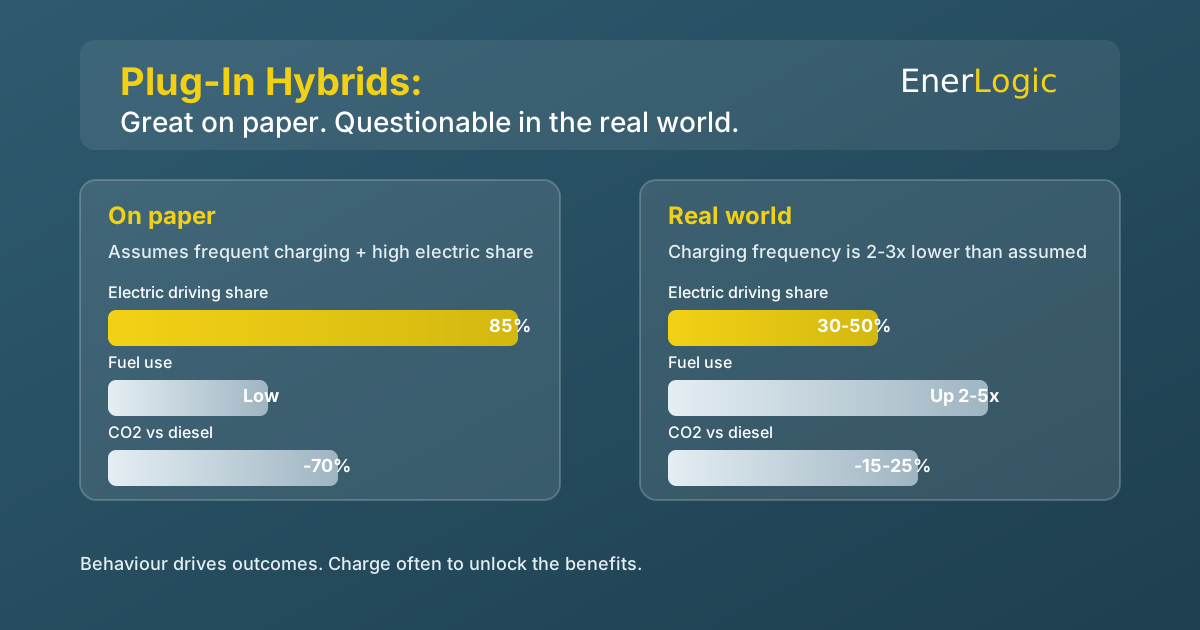
Plug-in hybrids (PHEVs) are usually sold as the sensible middle ground:
"Electric when you want it, petrol when you need it."
It sounds pragmatic. Reasonable. Reassuring.
But that framing hides a real problem: PHEVs only work if people behave better than they usually do123. And history — across energy, transport, and economics — tells us the same story every time:
Convenience always wins.
To understand why this matters, we need to start with the fundamentals: energy, efficiency, and what actually moves a vehicle.
The fuel vs EV reality people avoid talking about7
Liquid fuels are astonishingly energy-dense.
One litre of diesel contains roughly 10 kWh of chemical energy5. Petrol is slightly lower, but in the same ballpark. That density is precisely why humanity moved from horses and whale oil to liquid fuels so quickly.
But energy stored is not energy used.
A modern diesel engine converts only ~25–30% of that energy into motion7. The rest is lost as heat through the engine block, exhaust, cooling system, and drivetrain.
In practical terms:
1 litre of diesel delivers ~2.5–3 kWh of useful work at the wheels
By contrast, a battery-electric vehicle (BEV) converts ~85–90% of electrical energy into motion7.
That single difference explains almost everything else.
Why EVs "feel" more sensitive
This also answers a question many drivers notice immediately:
Why does an EV's range drop the moment you turn on the air-conditioning, while a diesel or petrol car barely reacts?
Because EVs are efficient.
In an internal-combustion vehicle, accessory loads (air-con, hills, wind, weight) are small compared to the huge baseline losses already occurring. They're hidden inside inefficiency.
In an EV:
- Every hill matters
- Every headwind matters
- Every kilowatt of air-conditioning shows up
Not because EVs are fragile — but because efficiency makes reality visible7.
"EVs just shift emissions to power stations"67
This argument refuses to die, and it ignores two fundamentals:
1. Efficiency
EVs need far less energy to move the same mass. Even when charged on fossil-heavy grids, total energy use is lower7.
2. Decarbonisation
Electricity grids get cleaner every year6. Engines do not.
A diesel vehicle bought today will emit roughly the same CO₂ in 10 years as it does now5.
A BEV bought today gets cleaner automatically — without asking the driver to change behaviour6.
Where plug-in hybrids go wrong1234
Logically, PHEVs should have been a temporary transition technology — a stepping stone from fuel to full electric.
Instead, we rushed early EVs to market with limited range. Consumers didn't trust the promise. And the industry responded by wedging in a compromise that tries to live in both worlds.
That's the core problem.
A PHEV carries:
- an engine
- a gearbox
- a fuel system
- a battery
- an electric motor
- power electronics
It inherits all the complexity of both systems, without fully committing to either.
Behaviour is the Achilles heel1239
If a PHEV is not plugged in regularly, what happens?
You get:
That's not a bridge.
That's a compromise — with interest.
PHEVs are conditionally clean, not automatically clean123.
And conditional technologies fail at scale because they rely on human discipline.
What the numbers actually say (15,000 km/year, 10-year life)568
When we model real vehicles using conservative assumptions — including embedded CO₂8, fuel burn5, oil changes, charging behaviour1239, and Australian evening grid intensity6 — the picture becomes very clear.
| Scenario | Operational CO₂ (t/yr) | Total incl embedded (t/yr) | Total lifetime CO₂ (t over 10 years) |
|---|---|---|---|
| A. Diesel ute 8.0 L/100 km, efficiency worsens over time |
3.42 | 4.32 | 43.2 |
| B. BYD Shark 6 – perfect user 80% electric, 80% solar charging |
0.89 | 2.09 | 20.9 |
| C. BYD Shark 6 – average user Occasional charging, grid evenings |
2.55 | 3.75 | 37.5 |
| D. BYD Shark 6 – convenience wins Rarely plugs in |
2.75 | 3.95 | 39.5 |
| E. BEV ute (Musso EV-class) 100% electric, 80% solar |
0.55 | 1.95 | 19.5 |
Read that again.
- A perfectly used PHEV performs well — but only under near-ideal behaviour.
- An average PHEV drifts alarmingly close to diesel.
- A poorly used PHEV is barely better than diesel at all.
- A full BEV ute wins outright, even with conservative assumptions.
This is the uncomfortable middle ground no one wants to talk about.
The BYD Shark 6 proves the point
On paper, the Shark 6 looks revolutionary:
- ~100 km electric range
- ~2.0 L/100 km advertised fuel use
- ~45 g/km CO₂
In reality:
- Perfect users halve lifetime emissions
- Average users barely reduce them
- Convenience-first users erase most of the benefit
That leads to the obvious question:
If you can plug in every night… why not just drive a BEV?
The diesel comparison nobody wants
A modern diesel ute:
- burns fuel as efficiently as combustion allows
- has predictable emissions
- does not rely on behavioural discipline
That's why poorly used PHEVs land alarmingly close to diesel — despite higher cost, weight, and complexity.
This is the dirty secret of PHEVs:
They are not automatically cleaner.
They are conditionally cleaner.
BEVs don't rely on willpower678
A BEV:
- has no oil changes
- has no tailpipe emissions
- has no "forgot to plug it in" failure mode
Even when:
BEVs still win on lifetime CO₂678.
And they get cleaner every year without asking the driver to do anything differently6.
The EnerLogic, no BS, position
PHEVs are not bad technology.
But they are bad policy bets if:
- incentives assume perfect charging123
- fleets don't enforce plug-in behaviour12
- buyers are shown best-case numbers only4
If you can charge every night, drive mostly short trips, and want a transitional option, a PHEV might make sense.
But if the goal is real emissions reduction at scale:
Do it once, do it right. A Full EV beats a hybrid without relying on human discipline Every. Single. Time.
EnerLogic
Straight to the point. No BS.
Sources & Methodology Notes
-
Real-world PHEV usage (Europe).
ICCT & Fraunhofer ISI (2022), Real-world usage of plug-in hybrid electric vehicles in Europe. Finds average electric driving share of ~45–49% for private users and ~11–15% for company cars, with real-world fuel use 3–5× higher than WLTP.
https://theicct.org/publication/real-world-phev-use-jun22/ ↩ -
Real-world PHEV usage (United States).
ICCT (2022), Real-world usage of plug-in hybrid electric vehicles in the United States. Shows real-world electric share 26–56% lower than EPA assumptions and fuel use 42–67% higher than label values.
https://theicct.org/publication/real-world-phev-us-dec22/ ↩ -
Utility factor overestimation.
ICCT (2020), Plug-in hybrid electric vehicles: A review of real-world usage. Documents that many PHEVs are not charged daily, undermining regulatory assumptions.
https://theicct.org/wp-content/uploads/2021/06/PHEV-FS-EN-sept2020-0.pdf ↩ -
Real-world vs test-cycle CO₂ emissions.
Fraunhofer ISI & ICCT (2022 update). Shows real-world PHEV CO₂ emissions 3–5× higher than official test values.
https://www.isi.fraunhofer.de/...Update-2022.pdf ↩ -
Australian fuel emission factors.
Australian Government, National Greenhouse Accounts Factors 2024–25. Provides official CO₂e factors for diesel and petrol combustion.
https://www.dcceew.gov.au/...factors-2025 ↩ -
Australian electricity grid emissions.
NGER / location-based Scope-2 electricity factors. Eastern-states grid typically ~0.6–0.8 kg CO₂e/kWh, higher during evening coal dispatch.
https://nettzero.com.au/blog/understanding-emission-factors ↩ -
ICE vs EV drivetrain efficiency.
U.S. Department of Energy, All-Electric Vehicles. ICE efficiency ~20–30%; BEV efficiency ~85–90%.
https://www.energy.gov/eere/vehicles/plug-electric-vehicles-and-batteries ↩ -
Battery manufacturing (embedded CO₂).
IVL Swedish Environmental Research Institute. Battery production emissions typically ~56–127 kg CO₂e per kWh.
https://www.ivl.se/...lithium-ion-batteries.html ↩ -
Charging behaviour sensitivity.
Plötz et al. (2023), Transportation Research Part D. Shows missed charging events materially reduce PHEV CO₂ benefits, especially in heavier vehicles.
https://www.sciencedirect.com/...S1361920923001189 ↩